When choosing a sunscreen, many consumers naturally gravitate toward the highest SPF available. The logic seems flawless: if SPF 50 is good, SPF 70 must be better, and SPF 100 surely offers the ultimate shield for the skin.
However, the truth is that the SPF number emblazoned on the packaging does not fully reflect the actual level of protection your skin receives during daily wear.
In fact, an under-applied SPF 100 product often delivers less protection than an SPF 50 formulation applied correctly.
What exactly is SPF? Is a higher SPF truly necessary? And what are the defining criteria for selecting the ideal sunscreen?
WHAT EXACTLY IS SPF?
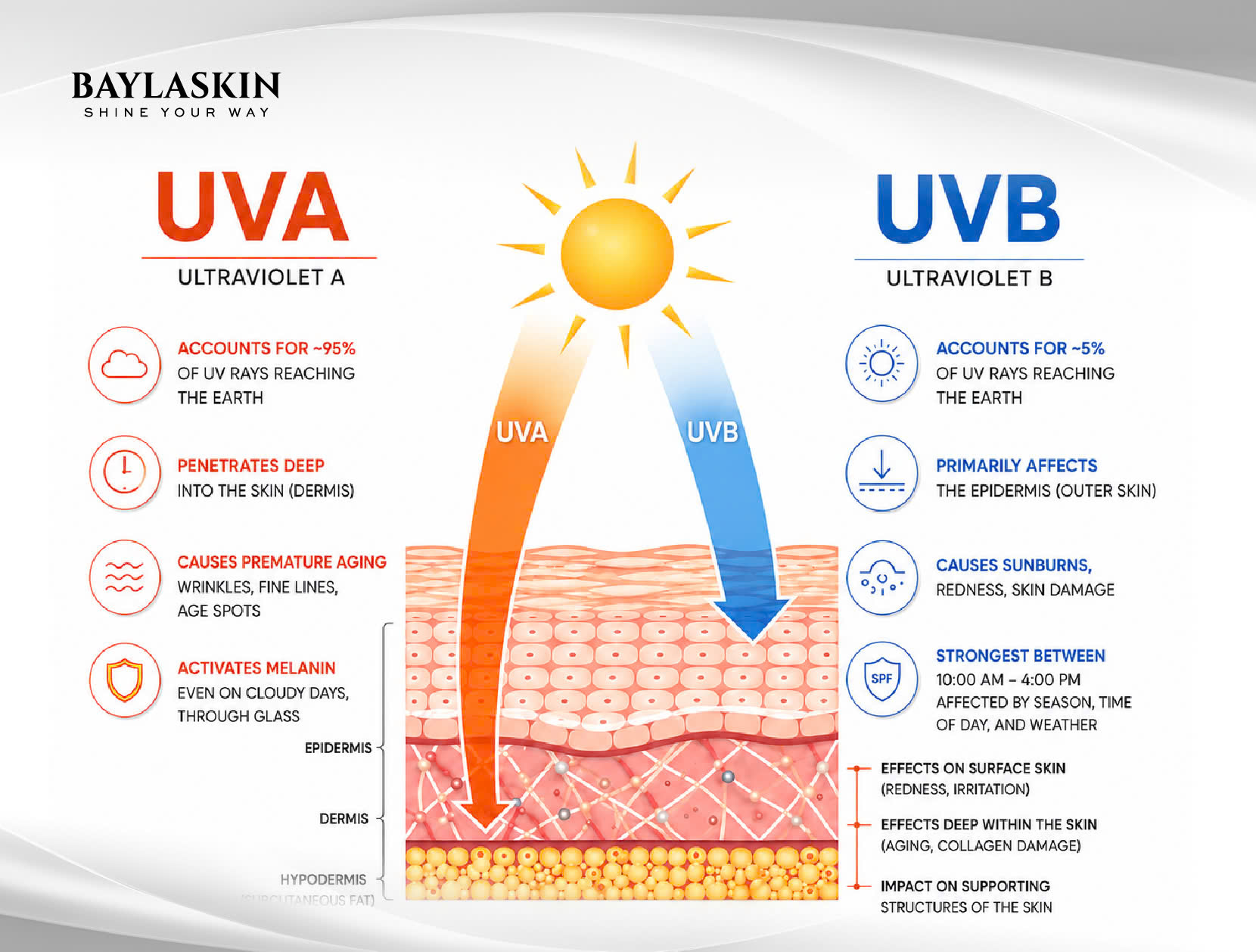
SPF (Sun Protection Factor) measures a product’s ability to shield the skin from UVB rays—the primary culprit behind sunburn, redness, and cellular DNA damage.
Under standardized laboratory testing conditions:
- SPF 30 filters approximately 97% of UVB radiation.
- SPF 50 filters approximately 98% of UVB radiation.
- SPF 100 filters approximately 99% of UVB radiation.
While the number 100 sounds vastly superior, the actual difference in protection between SPF 50 and SPF 100 is a mere 1%.
This marginal difference is why dermatologists universally agree that an SPF range between 30 and 50 is more than sufficient for standard daily sun exposure.
IN VIVO AND IN VITRO LAB TESTING VS. REAL-WORLD SPF EFFICACY
A critical nuance often overlooked is that published SPF ratings are derived from controlled laboratory environments rather than real-world usage.
In Vivo Testing (On Live Subjects)
This standard methodology tests formulations directly on human volunteers. Even so, results can fluctuate significantly based on individual biological variables such as:
- Diverse skin phototypes.
- Varying thicknesses of the stratum corneum (the outermost skin layer).
- Natural melanin levels.
- Inherent biological responses to UV radiation.
In Vitro Testing (In the Lab)
Modern advancements utilize substrates designed to mimic the human skin surface. However, these artificial models cannot fully replicate dynamic biological and environmental factors, such as:
- Sebum and sweat production.
- Natural skin creases and facial expressions.
- Friction from face masks and clothing.
- Harsh external environmental exposure.
In short, the stated SPF is a benchmark value established under pristine lab conditions, not a guarantee of absolute efficacy for every real-world scenario.
THE CARDINAL SIN OF SUNCARE: UNDER-APPLICATION
The single most common reason real-world sun protection falls drastically short of the label’s promise is inadequate application.
Standardized SPF clinical testing requires an application density of 2 mg/cm² of skin. For the average adult face, this translates to approximately:
- One-quarter (1/4) of a teaspoon.
- Or the length of two full fingers.
In reality, most consumers apply only 25% to 50% of the recommended amount. This leads to a critical biological consequence:
The Non-Linear Degradation of SPF
It is a common misconception that applying half the required amount of an SPF 50 sunscreen yields an SPF of 25. Unfortunately, sun protection degrades exponentially, meaning efficacy plummets far faster than the reduction in product volume. For instance:
- An SPF 50 product applied at half the standard volume may only provide an effective protection level of SPF 7 to 15.
- An under-applied SPF 30 formula drops to a negligible baseline of protection.
Consequently, someone wearing an inadequately applied SPF 100 sunscreen remains at a higher risk of UV damage than someone wearing a correctly measured dose of SPF 50.
The takeaway is clear: application volume dictates protection far more than chasing astronomical SPF numbers.
DOES A HIGHER SPF MEAN A SUPERIOR FORMULA?
To engineer ultra-high ratings like SPF 70 or SPF 100, cosmetic chemists must significantly increase the concentration of UV filters. This introduces formidable formulation challenges regarding texture:
- Higher volumes of solvents are required to dissolve the filters.
- A higher ratio of heavy oils is introduced to the product base.
- The resulting texture becomes noticeably thicker, stickier, and more prone to leaving a greasy residue.
- Achieving an elegant, weightless, and aesthetically pleasing skin feel becomes exceptionally difficult.
Particularly in humid, tropical climates like Vietnam, heavy, ultra-high SPF formulas can feel suffocating. This often causes consumers to skimp on application—counterproductively lowering their actual UV defense.
BEYOND SPF: CORE CRITERIA FOR SELECTING AN EFFECTIVE SUNSCREEN
An elite sunscreen cannot be judged by its SPF alone. Discriminating skincare consumers should prioritize the following parameters:
Comprehensive UVA Protection
UVA radiation accounts for roughly 95% of the UV light reaching the earth’s surface. It penetrates deeply into the dermis and acts as the primary catalyst for:
- Premature photoaging.
- Fine lines and deep wrinkles.
- Dark spots, melasma, and hyperpigmentation.
- Loss of skin elasticity and sagging.
Therefore, opting for a broad-spectrum formula with robust UVA metrics is exponentially more beneficial than upgrading from SPF 50 to SPF 100.
UV Filter Photostability
Not all UV filters maintain their integrity under prolonged sun exposure. Photostability is a critical, yet frequently overlooked, element of suncare efficacy.
Legacy filters can degrade rapidly when exposed to sunlight. For example, Avobenzone—a classic UVA filter—loses significant efficacy unless stabilized by specific companion ingredients.
In contrast, next-generation UV filters are engineered for superior photostability, ensuring sustained defense without breaking down. Sophisticated filters found in premium modern sunscreens include:
- Tinosorb S (Bis-Ethylhexyloxyphenol Methoxyphenyl Triazine): A highly stable, broad-spectrum filter covering both UVA and UVB.
- Tinosorb M (Methylene Bis-Benzotriazolyl Tetramethylbutylphenol): A hybrid filter that both absorbs and reflects UV rays.
- Uvinul A Plus (Diethylamino Hydroxybenzoyl Hexyl Benzoate): Offers exceptional, highly stable defense against long-wavelength UVA1 rays.
- Uvinul T 150 (Ethylhexyl Triazone): Recognized as one of the most powerful UVB filters on the market today.
- Mexoryl SX & Mexoryl XL: Highly acclaimed, photostable filters renowned for high-performance UVA protection.
By blending these innovative agents, modern formulations achieve impeccable broad-spectrum defense while maintaining a lightweight texture free from a heavy white cast or greasy finish.
Ultimately, discerning consumers should look beyond the SPF label to evaluate the overall UV filter network and UVA ratings. An SPF 50 formula utilizing advanced, photostable filters will routinely outperform an ultra-high SPF product built on an unstable filter matrix.
Cosmetic Elegance
A sunscreen that boasts a lightweight, breathable, and sensorially pleasing texture encourages better consumer habits:
- It ensures the user applies the full, necessary amount.
- It facilitates seamless reapplication throughout the day without pilling.
- It fosters long-term, daily compliance—the ultimate key to anti-aging.
In the real world, user experience is the ultimate arbiter of a product’s success.
THE IDEAL SUNCARE STRATEGY FOR TROPICAL CLIMATES
Given the hot and humid conditions in Vietnam, an SPF 30–50 paired with a PA+++ or PA++++ rating represents the sweet spot for daily wear. This range offers a formidable defense against UV damage while allowing the formulation to remain weightless and comfortable on the skin.
Rather than pursuing extreme SPF figures, your curation should favor:
- True broad-spectrum UVA/UVB protection.
- A photostable UV filter network.
- Maximum UVA shielding (PA+++ or PA++++, high PPD).
- A fluid texture that glides easily to allow full dosage.
- A finish devoid of white streaks or tacky residue.
- Formulations tailored to withstand humidity and sweat from daily lifestyles.
Indeed, skin experts agree that a beautifully formulated SPF 30–50 sunscreen, applied generously and reapplied diligently, delivers far superior protection than an SPF 100 cream that is avoided because it feels heavy, occlusive, or greasy.
At Bayla Skin, our philosophy centers on real-world efficacy rather than participating in the vanity metrics of the “SPF arms race.”
For instance, our Yuzu Glow Up Day Cream SPF30 PA+++ is intentionally calibrated for indoor professionals and corporate environments. Balancing reliable SPF 30 and UVA defense with deep hydration, it delivers daily comfort and effortless wearability.
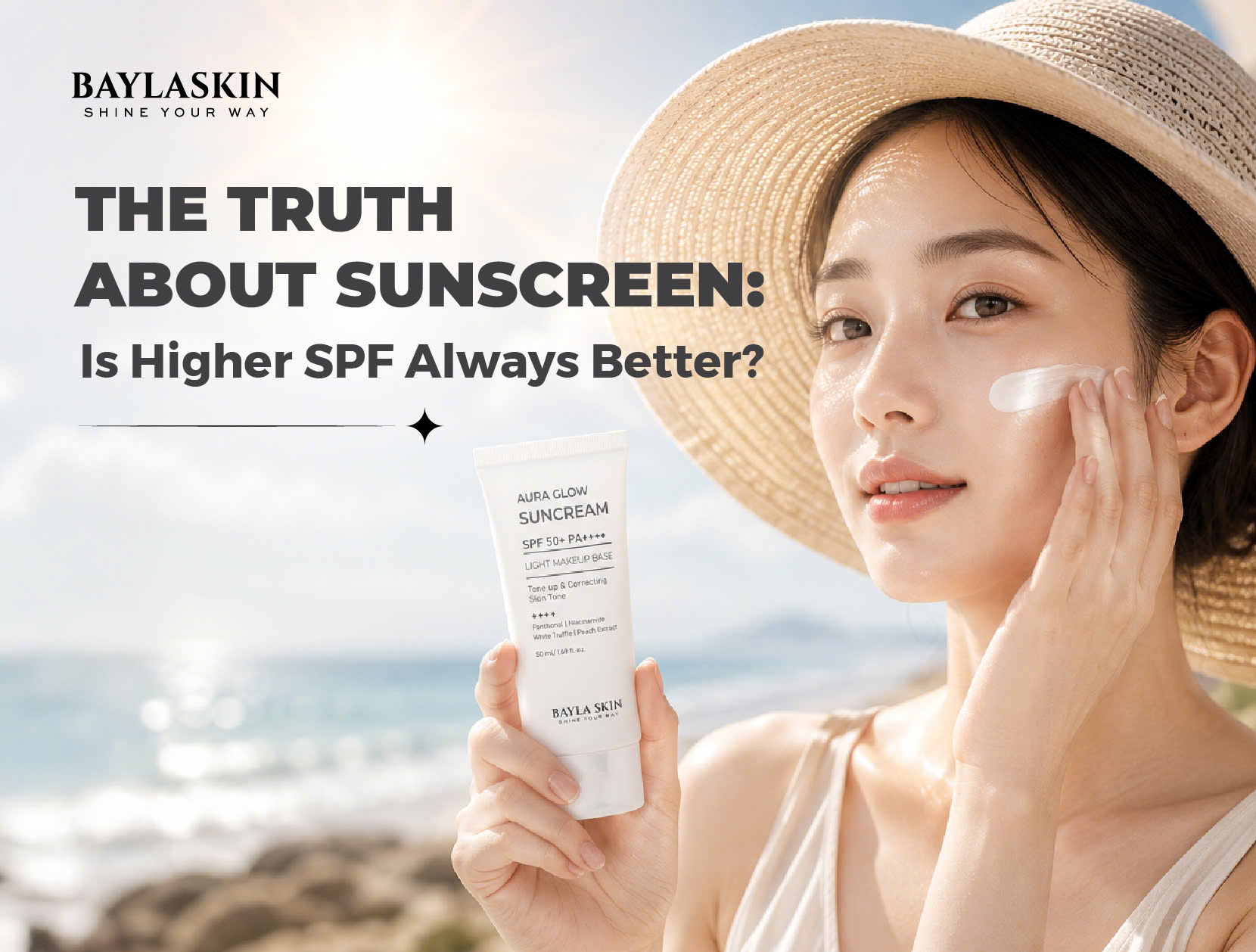
Conversely, the Aura Glow Suncream SPF50+ PA++++ is engineered for high-exposure scenarios and outdoor activities. Despite its advanced SPF50+ and PA++++ ratings, it retains an ultra-sheer, sophisticated finish that eliminates the chalky white cast typical of high-factor sunscreens, empowering users to apply the full recommended dose without feeling weighed down.
The secret does not lie in securing the highest number on the shelf; it lies in discovering a formula you love enough to apply properly, reapply consistently, and wear every single day. That is the true definition of real-world skin protection.
CONCLUSION
A higher SPF is not a universal synonym for a superior sunscreen.
In the grand scheme of dermatological defense, the performance gap between SPF 50 and SPF 100 is far narrower than marketing campaigns suggest. True protection relies on broad-spectrum coverage, advanced filter stability, proper dosing, and disciplined reapplication.
An SPF 50 sunscreen powered by next-generation UV filters and housed in a cosmetically elegant base will always shield your skin more effectively than an unappealing SPF 100 counterpart that compromises user compliance.
In modern skincare, that is the ultimate truth of effective sun protection.